๐Ÿ“„ Multicast Real World Example

Multicast Real World Example

Introduction


Below is a real world example of a multicast flow. 


Overview

โ€‹

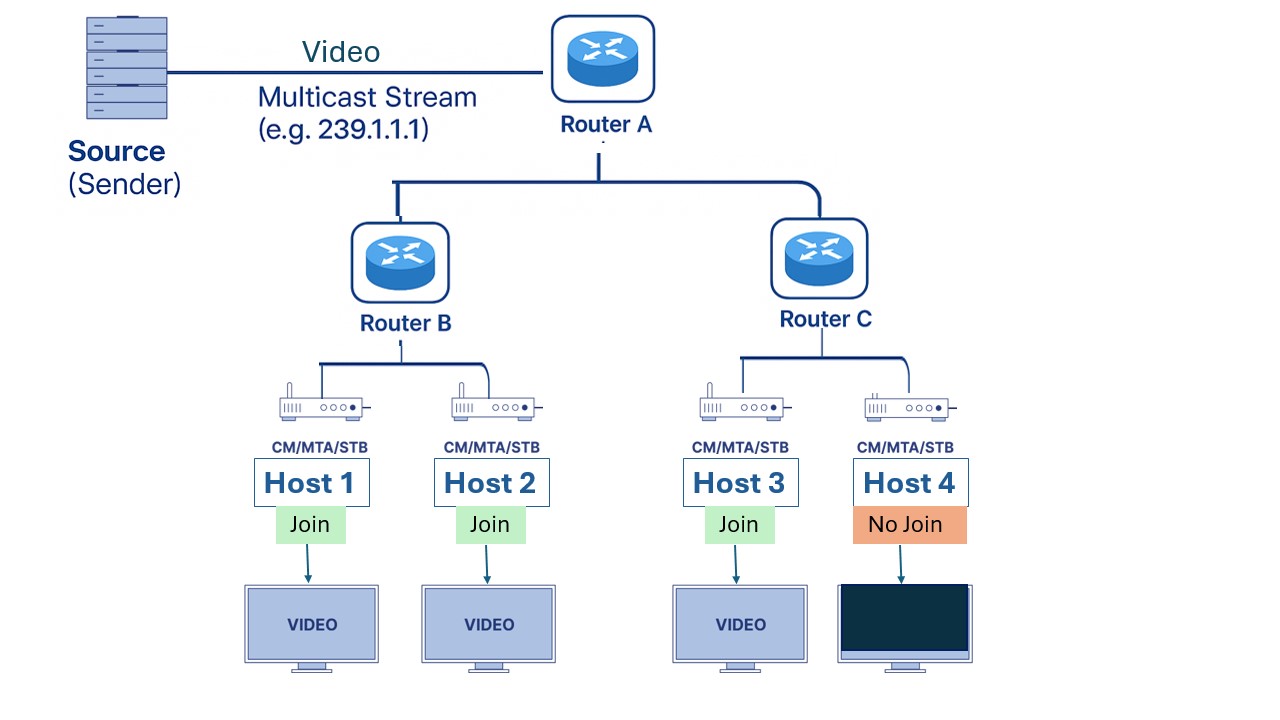
Multicast Packet Flow (Simplified Diagram)


Step-by-step flow:

  1. Source sends traffic to multicast group (e.g. 239.1.1.1)
  2. Routers build a distribution tree (via PIM)
  3. Hosts join using IGMP (IPv4) or MLD (IPv6)

    • Host1, Host2, Host3 โ†’ JOIN
    • Others โ†’ no traffic
  4. Traffic is forwarded only where needed

    • Router A sends one stream, not multiple copies
    • Replication happens closer to receivers

Key insight: duplication happens in the network, not at the source


Real World Example: IPTV (End-to-End)


Scenario

A telecom operator delivers live TV channels using multicast.

Components

  • Video Headend โ†’ Source of streams
  • Core Network โ†’ Runs PIM-SM
  • Access Network (DOCSIS/DSL/FTTH)
  • Set-Top Box (STB) โ†’ Receiver

Flow Breakdown

Step 1: Channel Streaming

  • Headend sends:

    Channel 1 โ†’ 239.10.10.1

    Channel 2 โ†’ 239.10.10.2

Step 2: User Changes Channel

  • User selects Channel 1
  • STB sends:

    IGMP JOIN 239.10.10.1

Step 3: Network Reaction

  • Access router receives IGMP JOIN
  • Signals upstream via PIM Join
  • Multicast tree is extended toward the user

Step 4: Traffic Delivery

  • Stream starts flowing:

    Headend โ†’ Core โ†’ Access โ†’ STB

  • If multiple users watch the same channel:
    ๐Ÿ‘‰ Only one stream per link, replicated near users

Step 5: Channel Change

  • User switches channel:

    IGMP LEAVE 239.10.10.1

    IGMP JOIN 239.10.10.2

  • Network:

    • Stops old stream (prune)
    • Starts new stream


Visual IPTV FLOW


Key Engineering Takeaways


  • IGMP = last-mile control (user joins/leaves)
  • PIM = backbone distribution
  • Efficiency comes from shared streams
  • Fast channel change depends on IGMP + network tuning