Multicast Refresher
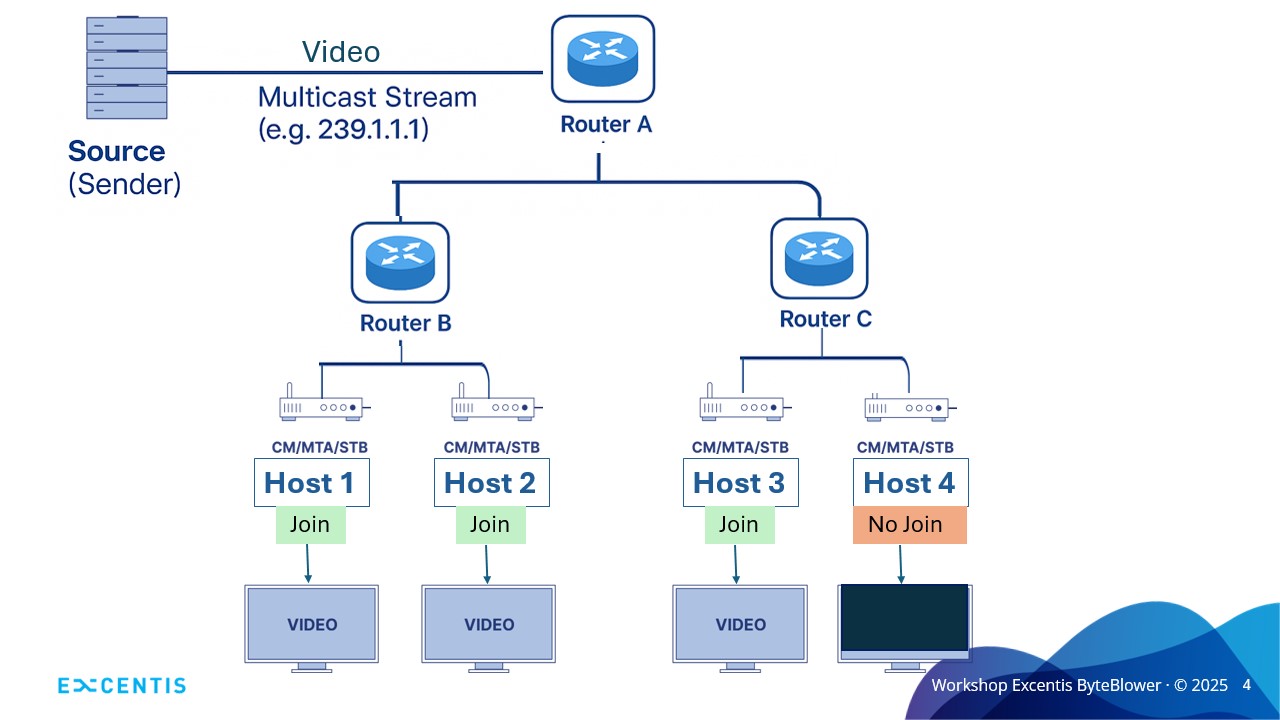
| Introduction | Multicast is a network communication method where one sender transmits data to multiple receivers simultaneously, but only to those that explicitly join the group. Multicast enables point-to-multipoint connections over Layer 3 networks utilizing IP addressing. Multicast sends traffic only to registered end-points that comprise a specific multicast group. This avoids flooding the entire network while still reaching numerous subscribers. It sits between Unicast (one to one) and Broadcast (one to everyone). Think of it as 1 → many (but only interested listeners). |
| Why Multicast? | Multicast is used to optimize bandwidth and scalability:
Common use cases: |
| Group Membership (IGMP/ MLD) | Hosts signal interest using:
What happens:
Version Features: IGMPv1/v2 and MLD: Hosts can only request to join a multicast group address and receive traffic from any source sending to that group. These do not have the capability to specify a particular sender or source; they only support Any-Source Multicast (ASM) IGMPv3 and MLDv2: Allows hosts to specify "INCLUDE" (only receive from X sender(s)) or "EXCLUDE" (reject X sender(s)) source lists. These support Source-Specific Multicast (SSM), filtering specific sources and only receive data from desired senders. |
| Multicast Routing Basics | Routers build distribution trees using multicast routing protocols like:
Two main modes:
Goal: Deliver traffic only to networks with active receivers. |
| Data Delivery Model | Multicast uses:
Implications:
|
| Key Challenges & Considerations | Engineers should watch for:
|
| Need More Info? | Here is a real world example on this KB: Multicast Real World Example Or contact us via our support portal: ByteBlower Support Portal |
|